Shelterfy is a privacy-first housing accountability and property intelligence system. The hardware, software, and AI behind it are built around one principle: hold the property accountable, give the resident the dignity of a closed door.
Shared housing often breaks down because messes go unattributed, leaks go undetected, damage goes unresolved, and operators have no fair way to hold anyone accountable. The obvious answer is also the wrong one: putting cameras everywhere destroys trust, creates legal exposure, and turns housing into surveillance.
That is the line. We measure access logs, room status, sensor data, and after-vacancy condition. We do not record people in private spaces. Every consequential decision routes to a human, with an appeal on record.
Smart locks, NFC, and QR codes log who entered and when. While the resident is inside a private room, no scan, camera, or microphone runs.
Door + occupancy + presence sensors must agree the room is empty before any inspection device activates. If presence becomes uncertain, the device retracts immediately.
AI sorts and prioritizes. People decide suspension, removal, or charges. Every consequential outcome has a written record and an appeal.
Issues route to restorative actions, a cleaning shift, a repair, mediation, before any access change. Access degrades before it disappears.
Shelterfy hardware is delivered as five interlocking kits. Operators do not need everything on day one. The minimum viable deployment is the Basic Accountability Kit. Robotics arrive only after the operating model is proven.
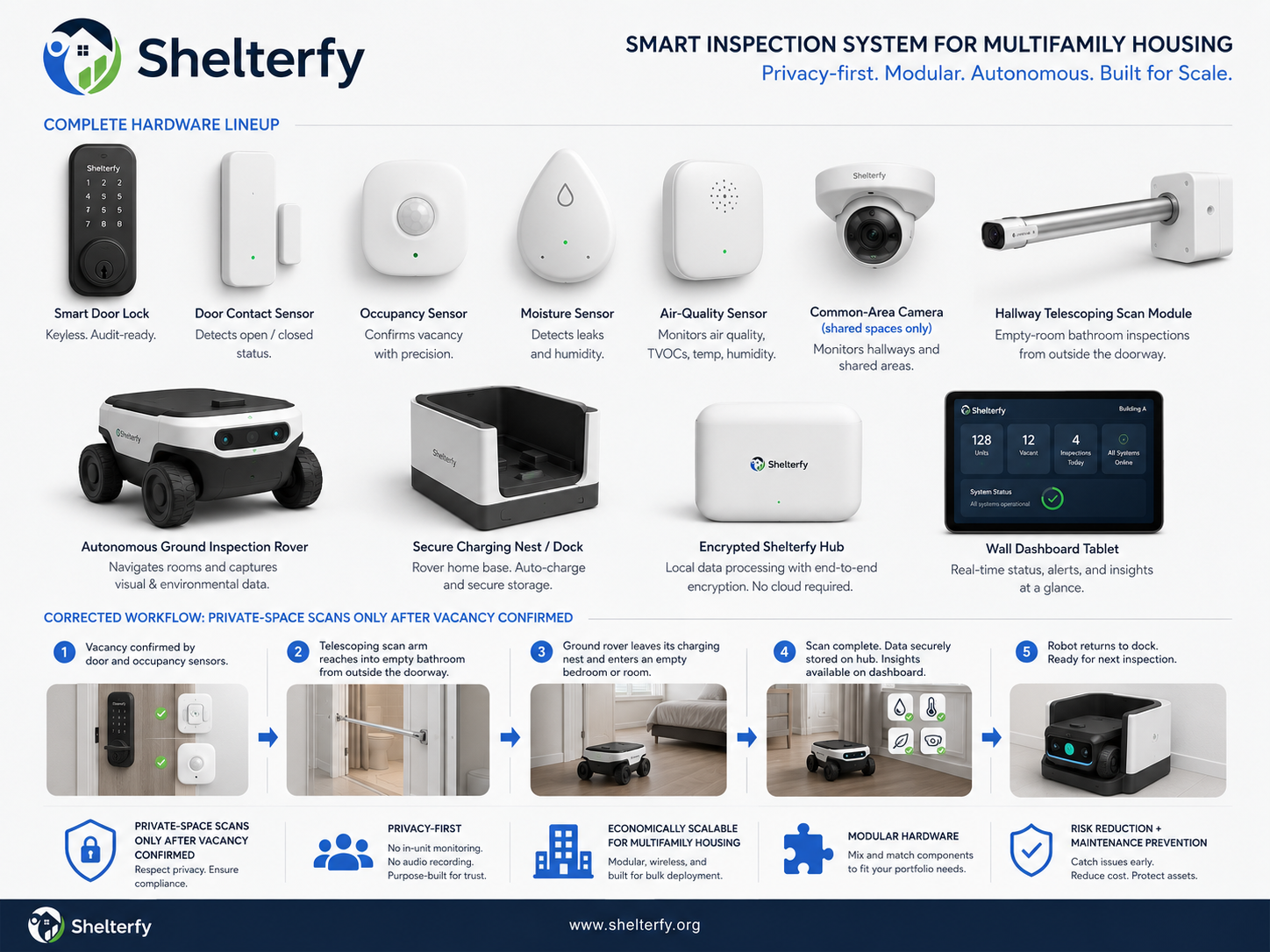
Smart locks, door + occupancy sensors, moisture + air quality sensors, local hub, wall dashboard, resident QR/NFC check-in. The MVP, no robotics required.
Common-area cameras, kitchen and laundry sensors, trash-area monitoring, smart appliance integration. Private rooms stay camera-free during use.
Wall- or ceiling-mounted module outside the bathroom. After vacancy is confirmed, a linear actuator extends a depth camera and inspection light. Retracts on any presence signal.
Docked when residents are present. Activates by schedule or vacancy trigger, navigates the room, captures floor-level inspection imagery, returns to charge.
The secure brain on the property. Edge AI, encrypted local storage, occupancy interlocks, cloud sync, offline access logic. Tamper alerts and fail-safe modes built in.
Every inspection device is hard-wired to refuse activation unless vacancy is confirmed. A scan in progress aborts the moment a presence signal returns.
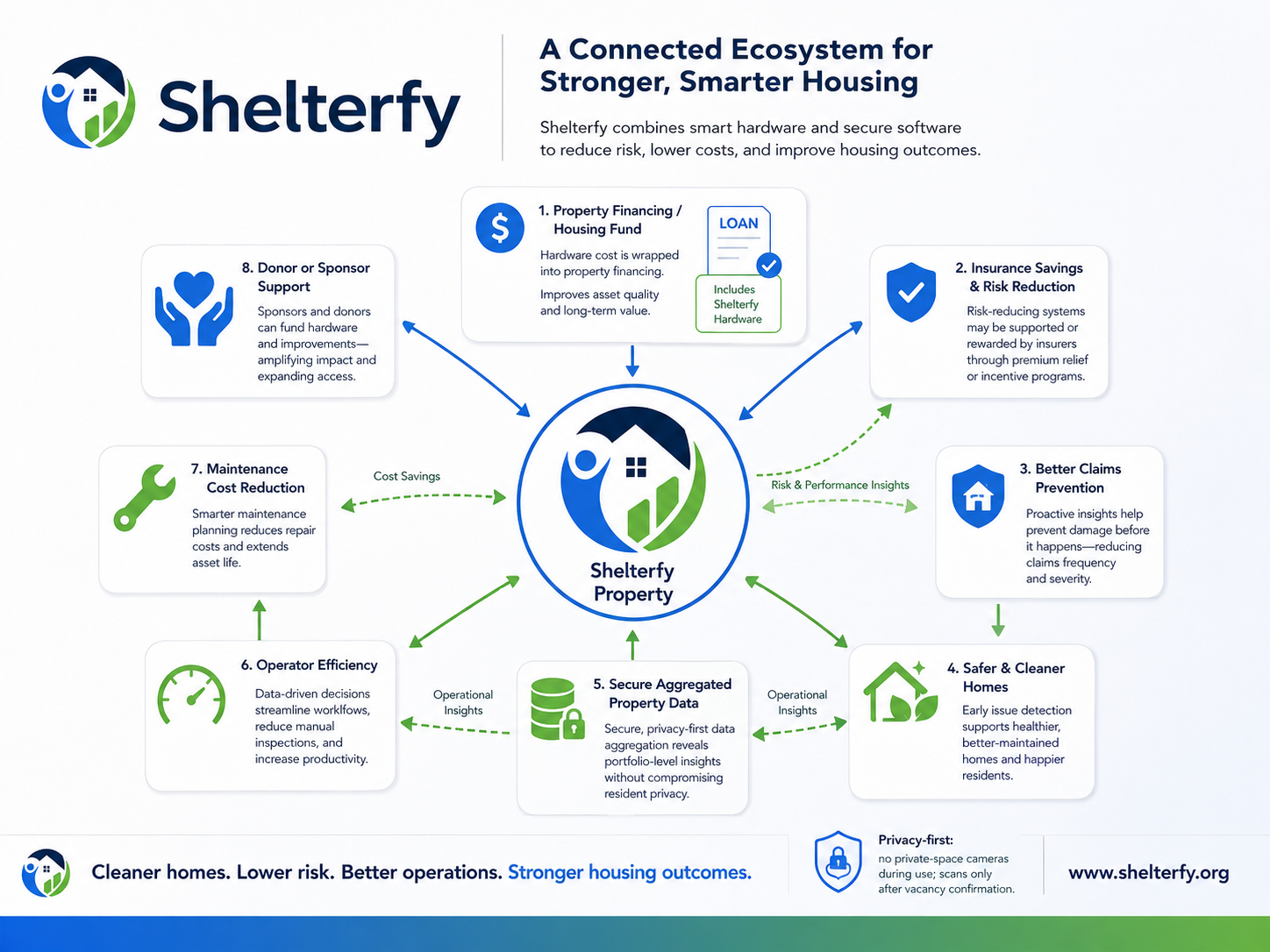
Shelterfy hardware is not a gadget expense. It is risk-reduction and operations infrastructure that funds itself through property acquisition budgets, renovation CapEx, sponsor contributions, insurance incentives, operator technology fees, and the maintenance savings the system itself produces. When the math works, the property pays for the system. When it doesn't, the deployment doesn't ship.
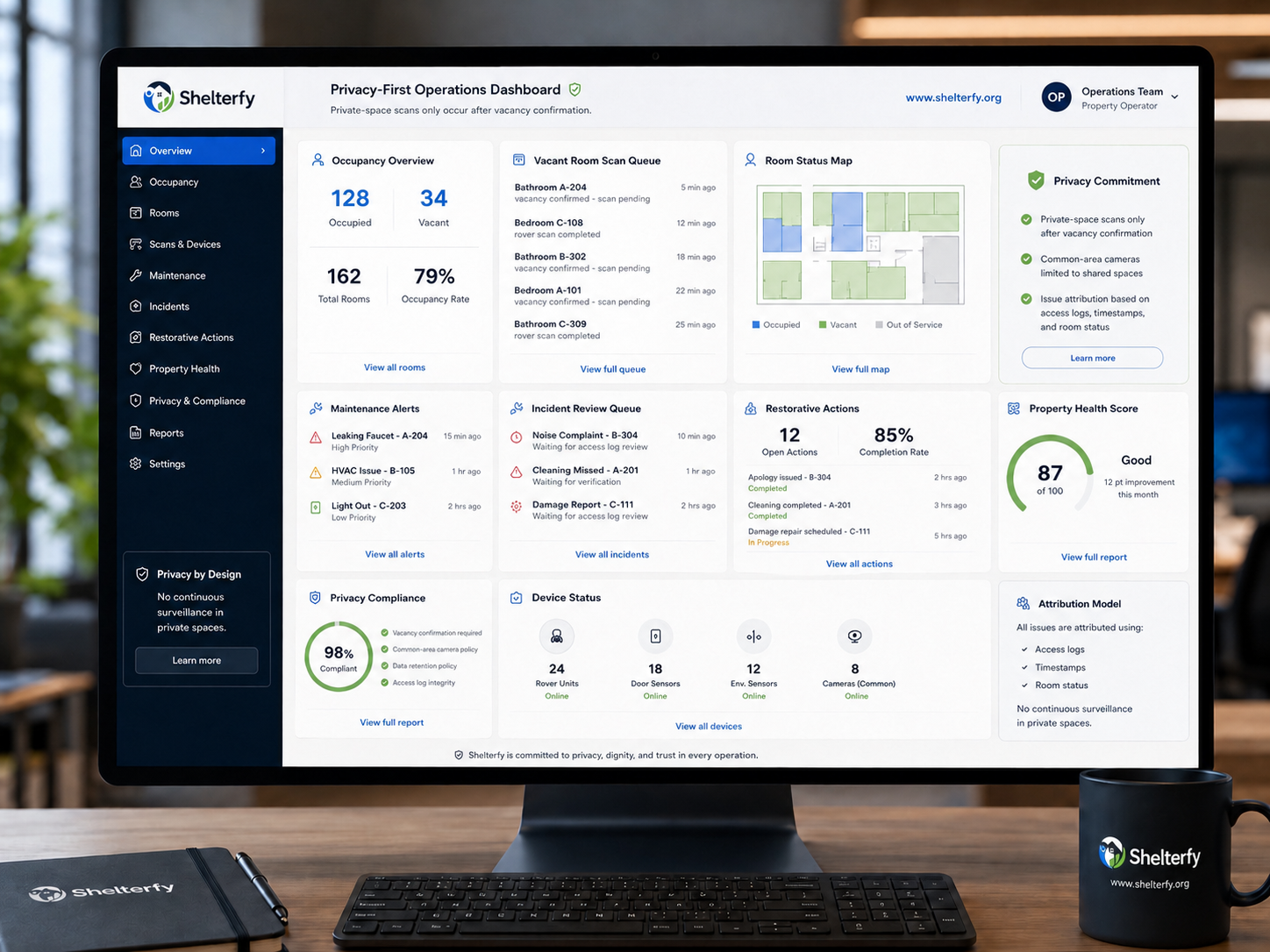
Every Shelterfy user gets a tailored surface. All four sit on the same operational data layer, so a sensor event in the field shows up in the operator dashboard, the resident's app, the sponsor's impact report, and the insurance risk panel without a separate integration project per stakeholder.
Real-time control of the property. Occupancy overview, vacant-room scan queue, room status map, property health score, device status, maintenance alerts, incident review queue, restorative actions, sponsor reporting, audit log. Privacy-first labels everywhere so a property manager can answer hard questions in the open.
Built to feel empowering, not surveillant. Digital ID, check-in / check-out, access QR / NFC, current booking, trust score, access level, active tasks, restorative action plan, premium amenities, job opportunities, ownership progress, savings progress, appeals, and a clear "what data is collected" section.
Campaigns, donations, product contributions, property sponsorship, resident-credit sponsorship, impact reports, hiring pipeline, geo-targeting, brand placement review. Sponsor metrics roll up by nights of housing supported, meals or hygiene kits provided, jobs created, ownership credits matched, and property-health improvement. Outcome reports without exposing personally identifiable resident data.
Property-level risk reports for insurance partners. Property health score, maintenance response time, leak history, fire / safety alerts, damage frequency, inspection coverage, claims prevention. The portal is engineered to expose risk-relevant aggregates, not resident behavior.
Shelterfy uses a two-rail AI model: a Physics Rail for hard rules that cannot be violated, and a Machine Learning Rail for classification, prediction, and recommendations. Neither rail decides serious consequences for a resident. Humans do.
Shelterfy uses a medallion data architecture. Every device event lands in Bronze first, immutable. Silver is the normalized operational layer that powers the dashboards and the resident app. Gold is reporting and analytics, rebuildable from Silver at any time.
Smart lock events. Door open / close. Occupancy readings. Moisture and air-quality readings. Scan events. Maintenance alerts. Resident check-ins. Sponsor contributions. Premium purchases. Every event preserved with its original timestamp.
Residents. Properties. Rooms. Bookings. Room status. Devices. Incidents. Trust events. Restorative actions. Ownership credits. Sponsor campaigns. Insurance reports. The structured records that the platform reads from.
Property health score. Trust distribution. Maintenance cost reduction. Sponsor impact. Insurance risk trends. Resident progress. Cleanliness compliance. Disposable, rebuilt from Silver.
Every major action carries an audit record. Access events, sensor logs, scan logs, incident reviews, restorative-action completions, ownership credits, sponsor contributions, maintenance costs, insurance-relevant property metrics. That trail is what protects the resident, the operator, and the platform.
This is the operating loop a Shelterfy property runs every time a private space is used. Nothing in the loop violates the core principle. Every step has a privacy guarantee.
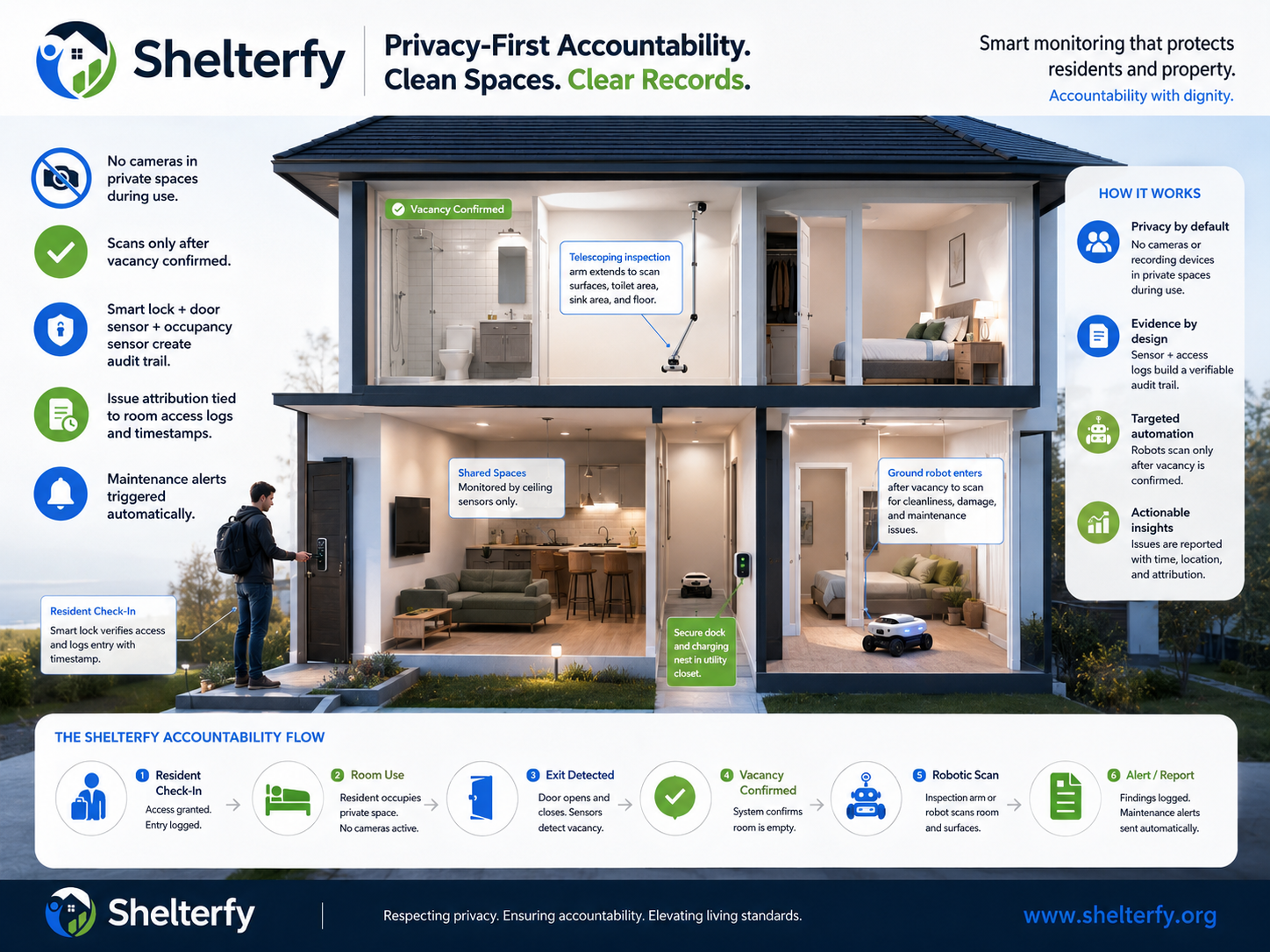
Every objection Shelterfy will face is anticipated in the system itself. The defense is structural, not rhetorical.
It isn't. There are no cameras or microphones in bathrooms, bedrooms, showers, or any private space during use. Private-room inspection only occurs after vacancy is confirmed. The system inspects property condition, not resident behavior.
It doesn't. Residents are stewards. Good behavior unlocks more access, better amenities, jobs, ownership progress. When mistakes happen, the system uses restorative actions before any access change.
It won't have the chance to. AI sorts and prioritizes. Humans decide suspension, removal, or charges. Every consequential outcome has a written record and an appeal.
We won't. The valuable Shelterfy data is property-level: leak frequency, damage frequency, maintenance response, room turnover, cleanliness compliance, claims prevention. Resident profiles are not for sale.
It is financed as property infrastructure. It reduces maintenance cost, damage cost, claims risk, staff time, vacancy loss, and sponsor uncertainty. It can be bundled into property financing, renovations, insurance incentives, sponsor programs, and platform fees.
Shelterfy is engineered to prove the operating model in software before it spends a dollar on robotics. Hardware complexity scales in only after the workflow is real.
Operator dashboard, resident app, property and room records, bookings, manual incident reporting, trust score, restorative actions, maintenance tickets, sponsor records, privacy policy module, audit logs.
Smart locks, door contact, occupancy, moisture, air quality. Local hub, room status map, device health. Vacancy-confirmation logic, validated.
Staff-assisted inspection app. Photo capture after vacancy. AI-supported classification. Human review queue. Evidence package builder.
Bathroom doorway / wall-mounted scan module. Linear actuator, camera + depth sensor, LED inspection light, occupancy interlock, emergency retract logic.
Docked rover, room navigation, visual + environmental scan, obstacle avoidance, return-to-dock, secure upload.
Hardware cost packaged into property acquisition, renovation, sponsor programs, insurance incentives, and platform subscription. Multi-property scale.
Operators, insurers, sponsors, and engineers: the full whitepaper is on request. The platform is being built now.
A path that goes further. Profit from Shelterfy helps fund housing access and connects residents to health, recovery, and vocational support through the US Foundation.